
The choice of credential format should follow purpose, not preference. Three questions structure the decision:
- Is cross-border institutional recognition required?
- Is legal standing under eIDAS required?
- Who is the primary consumer — a person’s professional profile, or an institutional process?
The framework on this page follows the Badges guide v1.1 (EUNIS SIG, July 2026), Badges and Digital Credentials in Higher Education, for the choice between Open Badges and EDC, and the VC guide v1.1 (EUNIS SIG, July 2026), Verifiable Credentials in Higher Education: W3C-VC and SD-JWT VC, for the choice of technical stack that comes after it.
Use case matrix
| Use case | Open Badge | EDC | Recommended |
|---|---|---|---|
| Informal participation / engagement | ✓ Well suited | Optional | Badge |
| Skills visibility / portfolio | ✓ Good | ✓ Better | EDC + optional badge |
| Formal microcredential (EU Council Rec. 2022) | ✗ Elements only as free text | ✓ Structured ELM fields | EDC only |
| Transcript / diploma | ✗ Poor fit | ✓ Strong | EDC only |
| Cross-border recognition | ✗ Not supported | ✓ Strong | EDC only |
| Erasmus / mobility workflows | ✗ Not supported | ✓ Strong | EDC only |
| Regulated profession evidence | ✗ Poor fit | ✓ Strong | EDC only |
| Engagement during learning (milestones) | ✓ Well suited | Not needed | Badge |
| Social sharing alongside formal credential | ✓ Well suited | Underlying record | Badge + EDC |
A microcredential in the sense of the EU Council Recommendation (2022) is hard to implement reliably as an Open Badge alone.
The Recommendation is non-binding and does not prescribe a format, but it lists mandatory elements, such as the EQF level, ECTS workload, type of assessment, quality assurance and issuer identity, that have no agreed structured equivalent in the Open Badges specification. A badge can carry them only as free text or custom extensions, which receivers cannot process consistently.
These fields are defined by the European Learning Model (ELM), which only EDC implements.
Open Badge = how the learner shares and communicates the achievement.
EDC = how the institution accredits it and society recognises it.
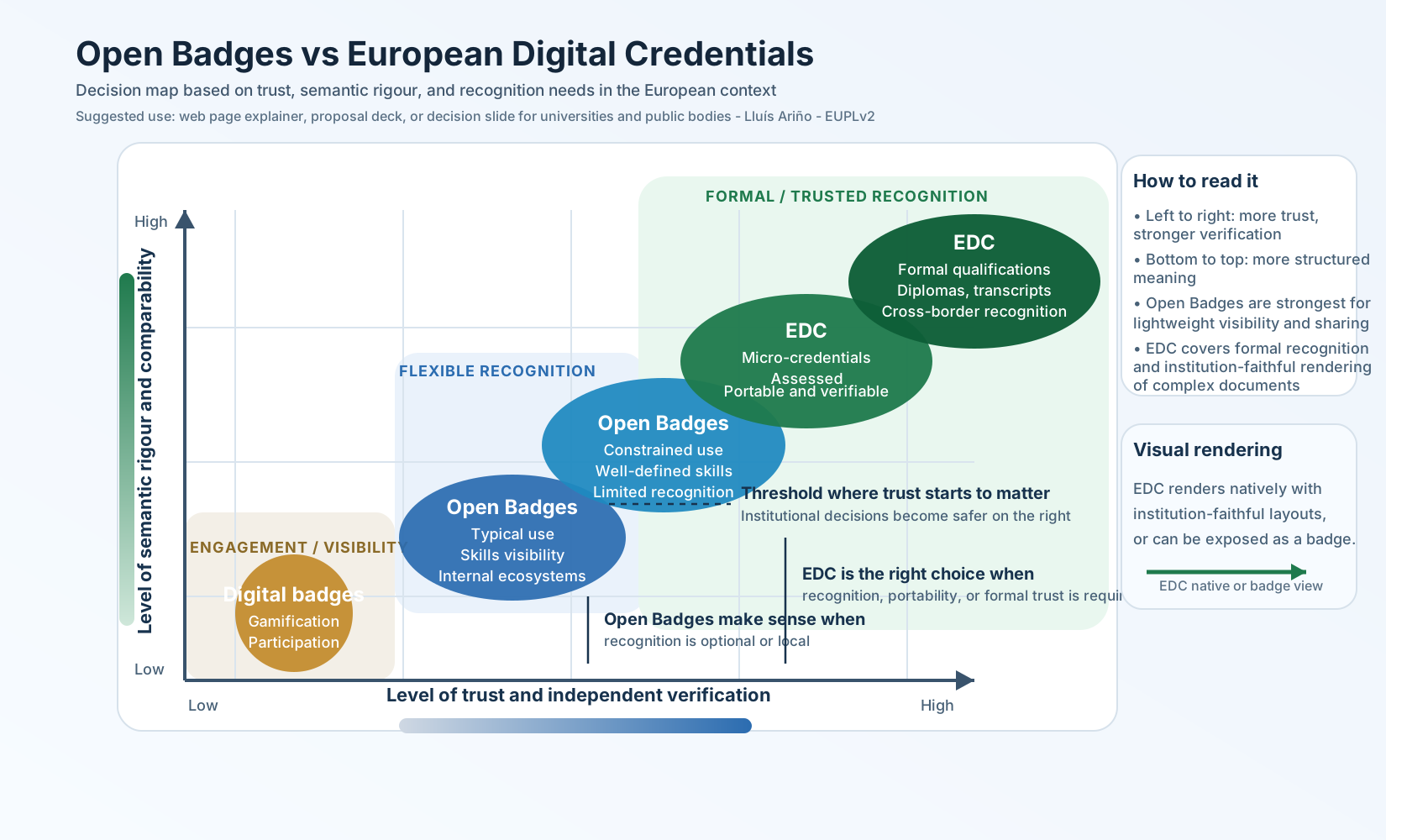
Decision map: trust and semantic rigour
The diagram below places the main credential formats on two axes: trust and independent verification (horizontal), and semantic rigour and comparability (vertical). It makes visible why Open Badges and EDC occupy different spaces — and when each is the right choice.
Data transfer models
Before choosing an EDC lineage, establish how the data needs to travel. Who sends the credential to whom, and whether the learner sits in the middle, decides most of the lineage question:
| Model | How the data travels | EDC lineage that fits |
|---|---|---|
| LE → NP (legal entity to natural person) | The university issues the credential to the student, who keeps it and shares it when needed. Typical cases: diploma, transcript, microcredential. | Either lineage: Europass/EDCI or DC4EU/EBSI |
| LE → LE (legal entity to legal entity) | One institution sends data straight to another, with no learner in between. Typical case: a partner university checking enrolment for an Erasmus exchange. | Usually SDG/OOTS, Europass/EDCI or a direct API |
| LE → NP → LE (citizen-mediated) | The learner receives the credential, holds it in a wallet and presents it to a relying party. Typical case: a student showing an EducationalID at a host university. | The wallet paradigm of DC4EU/EBSI and eIDAS 2.0 |
The two lineages themselves are described in European Digital Credentials.
Choosing between EDC lineages
Once an institution has decided to issue EDC, the choice between Europass/EDCI and DC4EU/EBSI is determined by use case, timeline, and data transfer model:
| Question | Europass / EDCI | DC4EU / EBSI / eIDAS 2.0 |
|---|---|---|
| Do you need to deploy formal credentials today? | Yes — production-ready | Not as an EU-wide service: the DC4EU pilot concluded in 2025 |
| Is the citizen the intermediary? (LE→NP→LE) | Partial support | Primary design target |
| Do you need EUDI Wallet compatibility? | No (file-based delivery) | Not guaranteed today: W3C VCDM is not a binding EUDI Wallet format; support for education is foreseen once new profiles exist |
| Is eIDAS 2.0 QEAA required? | No — eIDAS 1.0 seals | Designed for QEAA and PubEAA issuance; a qualified attestation delivered to the EUDI Wallet travels as SD-JWT VC or mdoc today |
| Is long-term cross-border wallet use the goal? | Transitional solution | Strategic target |
Since Implementing Regulation (EU) 2026/1731 (in force 11 August 2026), the binding annexes of the EUDI Wallet implementing acts name SD-JWT VC and ISO/IEC mdoc for person identification data and for attestations. W3C VCDM is not among them today, but the regulation’s recitals say wallets should also support it, as the reference format for attestations in education, once new W3C VCDM profiles are available. ARF v3.0 currently treats W3C VCDM as optional and for non-qualified attestations only. See EUDI Wallet.
Then choose the stack
Deciding between a badge and an EDC, and between lineages, still leaves a technical question: which verifiable credential stack carries each credential, W3C-VC or SD-JWT VC. Neither is better in the abstract. Start from the credential, not the stacks, and describe each credential type in the portfolio on five dimensions:
- Lifespan: presented for decades, or short-lived and reissued often?
- Audience: verifiers who are strangers abroad, or members of a scheme you already coordinate with?
- Semantic density: qualification levels, credits and learning outcomes that must keep their meaning across systems, or a few self-evident attributes?
- Status complexity: can it ever legitimately be put on hold, or is it only ever valid, expired or revoked?
- Regulatory exposure: inside the perimeter of eIDAS 2.0 and GDPR obligations that name technical properties, or outside it?
Short-lived, intra-scheme, semantically light credentials such as student ID or enrolment proofs point to SD-JWT VC; long-lived, cross-border, regulated ones such as degrees and formal microcredentials point to W3C-VC. Most universities will therefore run both, in two lanes. Choosing a stack works through the dimensions and the two lanes in detail.
To see the framework applied to seven concrete university situations, from microcredentials to employer checks, read the use-case scenarios.