
For universities, one of the most useful practical points is that Open Badges and EDC do not exclude each other. They serve different purposes and audiences, and can be designed to work together in one coherent institutional architecture.
The model on this page follows the Badges guide v1.1 (EUNIS SIG, July 2026), Badges and Digital Credentials in Higher Education. It starts from what the two standards have in common.
The shared technical foundation
Open Badges 3.0 and EDC in the DC4EU/EBSI lineage both rest on the W3C Verifiable Credentials Data Model (W3C-VCDM). That common base is what makes it technically possible to combine them. It is also why the combination needs care: two credentials built on the same data model are not, for that reason alone, equivalent for recognition.
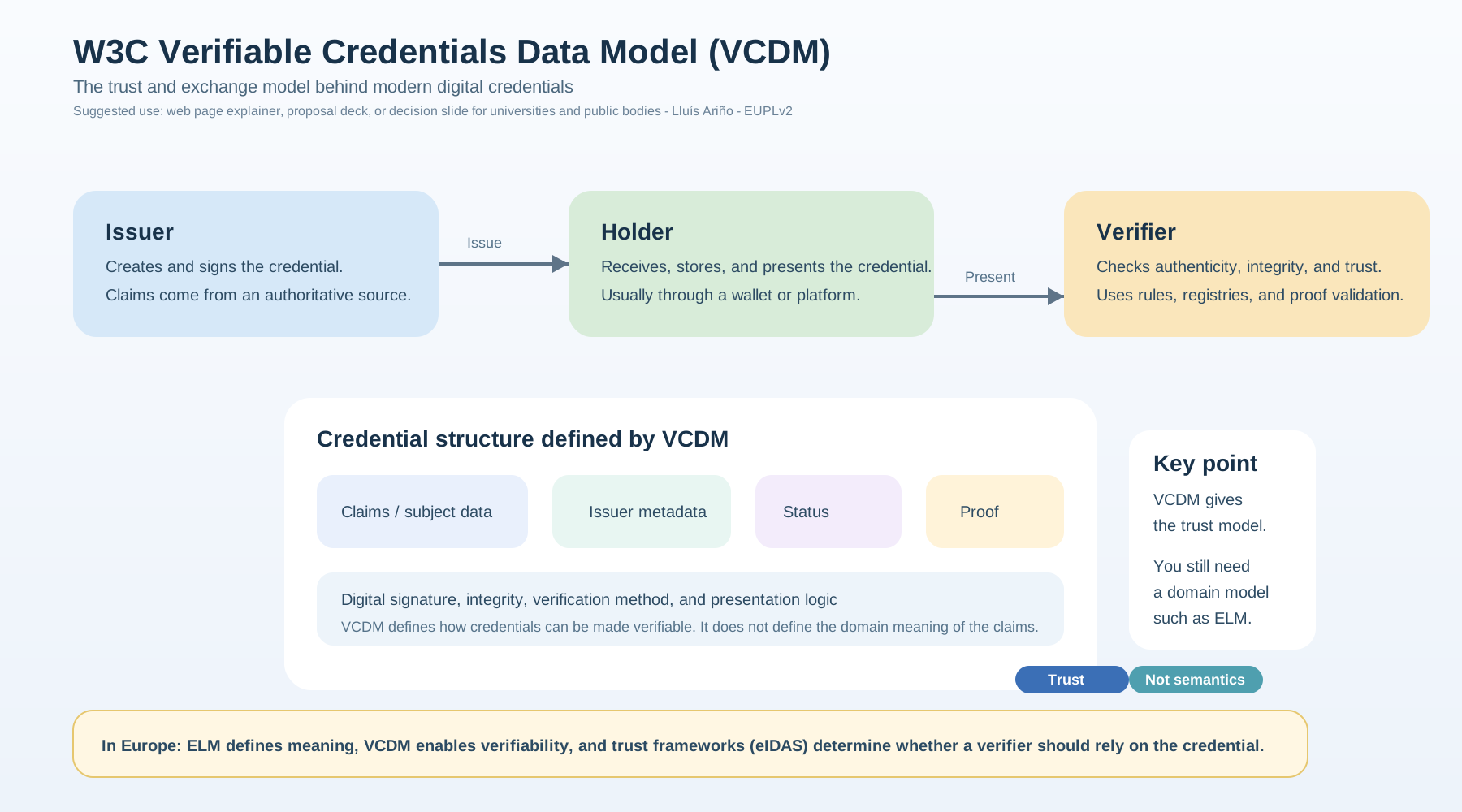
The data model sets out three roles. The issuer creates and signs the credential, the holder keeps it and presents it, and the verifier checks it without having to contact the issuer. Open Badges 3.0 and EDC both implement this triangle. What separates them is the layer on top: EDC adds the European Learning Model (ELM), the shared semantics that formal European recognition depends on. The data model supplies the same trust plumbing to both; ELM supplies the educational meaning only to EDC.
“W3C-VCDM gives the trust model. ELM gives the meaning. eIDAS gives the legal framework.”
Badges guide v1.1 (EUNIS SIG, July 2026)
Technical compatibility between Open Badges 3.0 and EDC therefore does not imply semantic or legal equivalence. Note also that W3C-VCDM is not yet a binding format for the EUDI Wallet; see EUDI Wallet for the current position.
The layered architecture
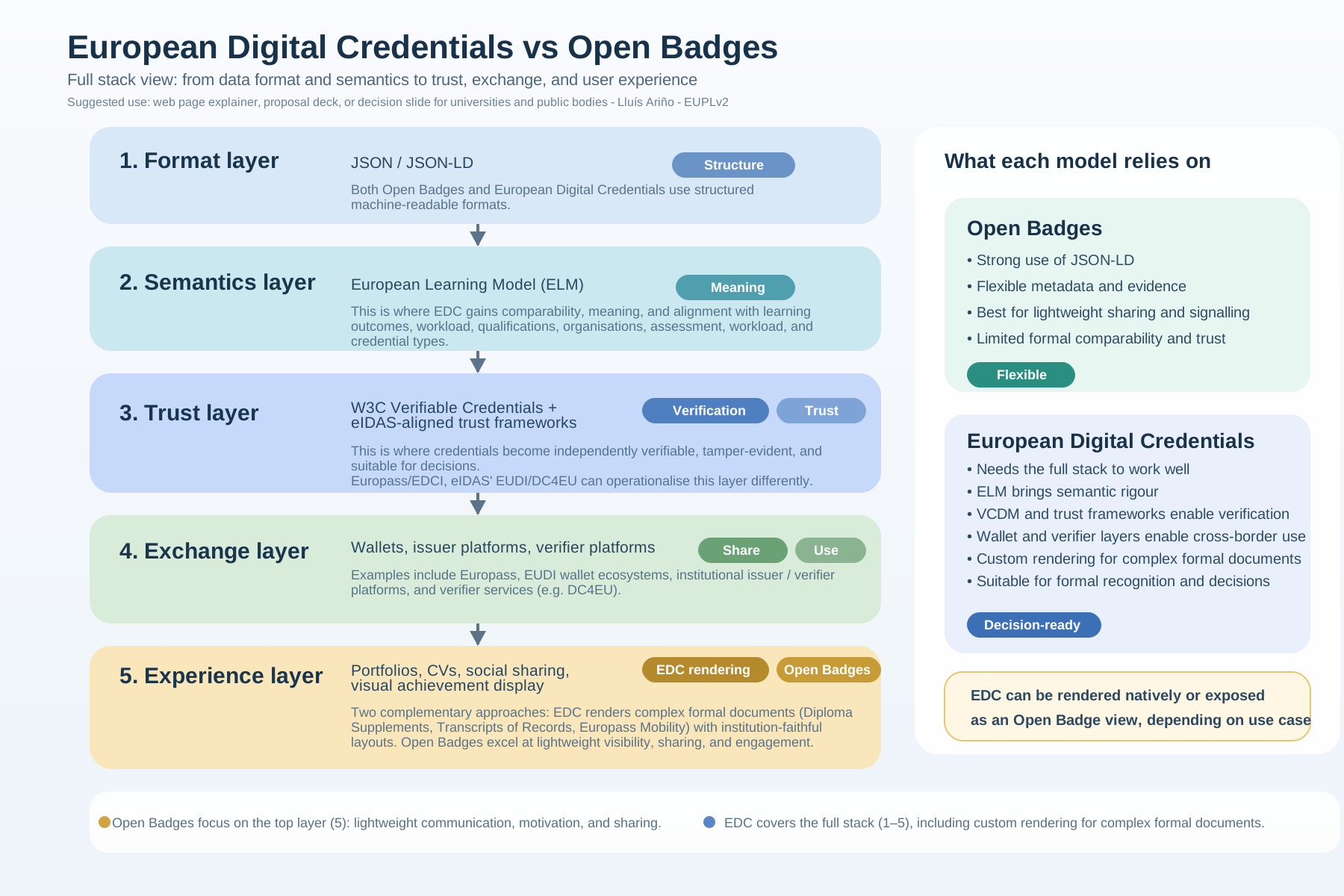
The architecture that actually works positions each standard at the layer where it adds most value:
| Layer | Role | Standard |
|---|---|---|
| Layer 0 — Academic source systems | Student information system, diploma registry, QA registry, identity systems. The authoritative data source. | Institutional (SIS, LMS, QA systems) |
| Layer 1 — Trust and governance | Trusted issuer registration, qualified signatures, eIDAS identity framework, awarding authority governance. | EDC / eIDAS 2.0 / EBSI |
| Layer 2 — Verifiable credential | Signed, machine-readable, independently verifiable formal record. The credential that institutions, employers, and border authorities can trust. | EDC (ELM + W3C-VCDM) |
| Layer 3 — Experience and engagement | Social sharing, portfolio visibility, motivation during learning, labour market signalling. Optional but valuable. | Open Badge (optional) |
Badge = view. EDC = evidence. Trust = governance. Each layer has a defined role; none substitutes for another. See the interactive interoperability map for a visual exploration of these layers across credentials and trust frameworks.
Practical combination scenarios
| Scenario | How it works | Who benefits |
|---|---|---|
| EDC microcredential + social badge | Issue an EDC microcredential as the formal institutional record. Issue an Open Badge referencing the EDC for the learner’s professional profile and portfolio. | Registry (EDC) + learner visibility (badge) |
| Engagement layer + formal record at completion | Use Open Badges during learning for milestones, participation, and skills. Issue an EDC at programme completion as the formal verified record. | Learner motivation during + institutional recognition after |
| Alliance badge over institutional EDC | Each partner institution issues its own EDC. The alliance issues a shared Open Badge representing the joint programme — no legal entity at alliance level required for the badge layer. | Alliance branding without governance complexity |
| Badge as a window into a credential | Issue a lightweight badge that surfaces and links to the verifiable EDC underneath — combining social shareability with offline-verifiable formal record. | Both communities: labour market + institutional recognition |
Technical note on OB v3.0 and EDC compatibility
Because Open Badges v3.0 and EDC in the DC4EU/EBSI lineage share the W3C-VCDM foundation described above:
- A v3.0 badge can technically be issued as a verifiable credential
- An EDC can be rendered as, or alongside, an Open Badge for social sharing
- Evidence from a badge can be referenced within an EDC
However, there is not yet a settled interoperability profile between Open Badges v3.0 and EDC in production deployments. Standards alignment is ongoing. This is an area where the EUNIS SIG can contribute actively — by documenting emerging practice, identifying gaps, and feeding into the standards conversation.
← Use-case scenarios · Higher education · Implications by function →