
The W3C Verifiable Credentials Data Model is the shared technical foundation of European Digital Credentials (DC4EU/EBSI lineage) and Open Badges v3.0. It is one of the two stacks that dominate verifiable credentials today (see Two stacks, not two flavours), and the one that answers both of the architectural questions in a particular way: meaning lives inside the signed credential, and the proof is a detachable layer. This page explains what that means and what it costs, drawing on the VC guide v1.1 (EUNIS SIG, July 2026), Verifiable Credentials in Higher Education: W3C-VC and SD-JWT VC, and the Badges guide v1.1 (EUNIS SIG, July 2026), Badges and Digital Credentials in Higher Education, both published by the EUNIS Special Interest Group – Mobility & Digital Credentials (EUNIS SIG).
The triangle, briefly
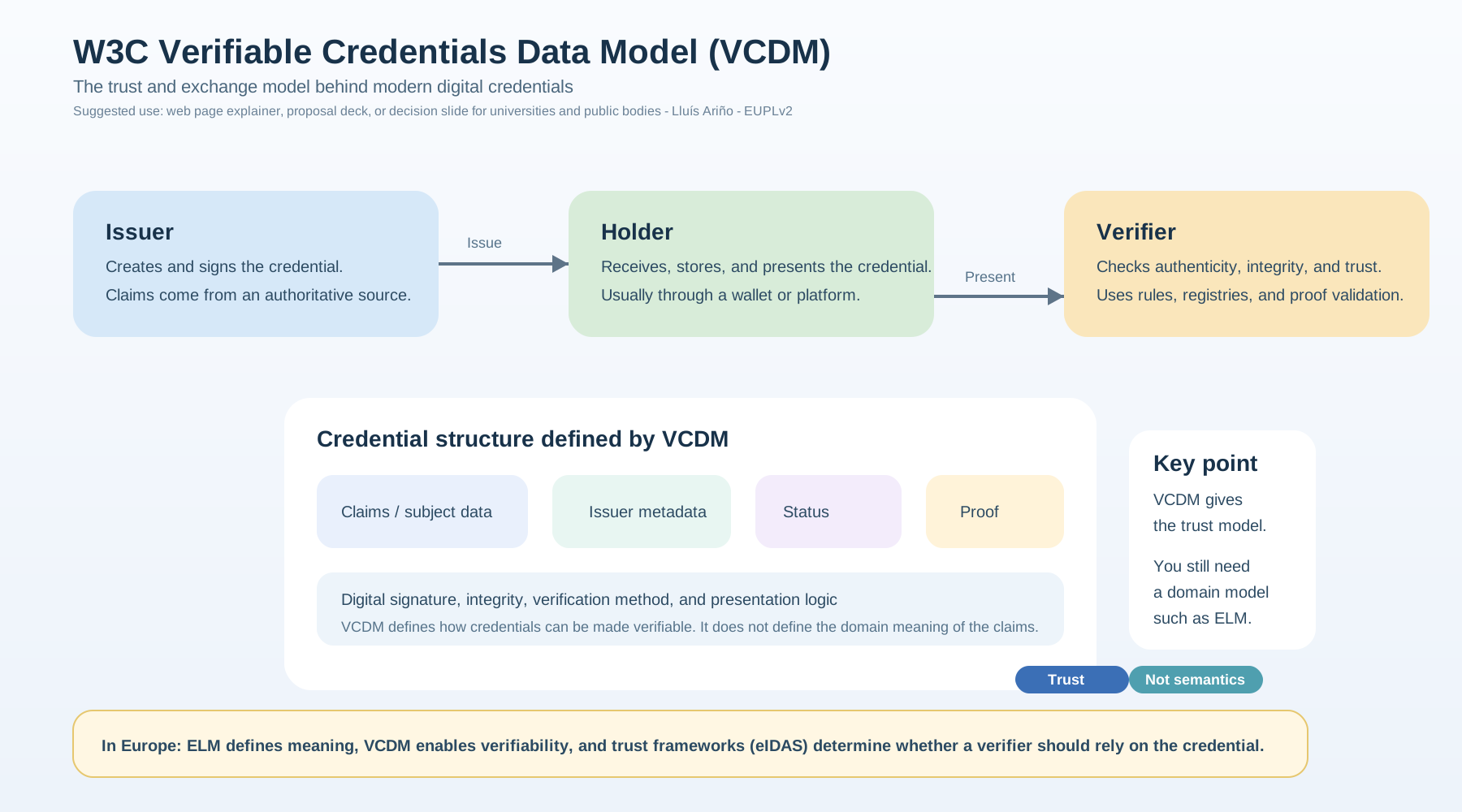
The model defines three roles: the issuer creates and signs the credential, the holder stores and presents it, and the verifier checks it independently, without contacting the issuer. Both stacks implement this triangle; Verifiable credentials covers it in detail. What distinguishes the W3C-VC stack is what sits on and around it. In the Badges guide’s formula: “W3C-VCDM gives the trust model. ELM gives the meaning. eIDAS gives the legal framework.” European Digital Credentials (EDC) add the European Learning Model (ELM) on top, which is what makes them fit for formal European recognition; Open Badges v3.0 shares the plumbing but not that semantic layer, so technical compatibility does not mean semantic or legal equivalence.
A data model, not a signature format
VCDM 2.0 (a W3C Recommendation) specifies the shape of a credential: subject claims, who issued it, when it is valid (validFrom, validUntil), where to check its status, which schemas apply, and a proof. How the credential gets signed is left to other specifications. That split is intentional and, as shown below, it is what gives the stack its longevity.
The serialisation is JSON-LD, which is plain JSON plus one decisive addition: the @context. Carried inside the credential, the context is a machine-readable statement tying each field name to a published definition under someone’s governance.
It signs meaning, not just data
Because the @context sits inside the signed payload, the issuer’s signature covers the data and its interpretation together. Alter the context and the signature breaks. A verifier who validates the proof has validated what the credential means, not merely which characters it contains. This closes off a whole class of failure: a signed value that stays cryptographically valid while its interpretation drifts between issuer and verifier.
Take the site’s worked example: the URV Master’s in Computing, EQF level 7, issued in 2026 to Aina. In the scenario, and in simplified form, URV signs something like this:
{
  "@context": [ "https://www.w3.org/ns/credentials/v2",
                "http://data.europa.eu/snb/model/context/edc-ap" ],
  "type": [ "VerifiableCredential", "EuropeanDigitalCredential" ],
  "issuer": { "id": "did:ebsi:z...URV",
              "eidasLegalIdentifier": { "notation": "Q9350003A", "spatial": ".../country/ESP" } },
  "validFrom": "2026-07-01T00:00:00Z",
  "credentialSubject": { "hasClaim": { "specifiedBy": {
      "eqfLevel": "http://data.europa.eu/snb/eqf/7",
      "iscedFCode": "http://data.europa.eu/snb/isced-f/0619" } } },
  "credentialSchema": [ { "type": "JsonSchema", "id": ".../tsr/v3/schemas/0x05332a..." },
                        { "type": "ShaclValidator2017", "id": ".../tsr/v3/schemas/0x..." } ],
  "proof": { "type": "DataIntegrityProof", "cryptosuite": "ecdsa-rdfc-2019", ... }
}
Inside the signature is not the number 7 but the IRI of the governed EQF concept; not the string “computing” but an ISCED-F code; not a bare URL as issuer but a DID resolvable in the EBSI registries, with an eIDAS legal identifier and an explicit jurisdiction. The signature attests concepts, identity and validation rules together.
Shared European ontologies
The fields resolve to ontologies built once, at European level: ELM for the credential structure, EQF for levels, ISCED-F for fields of study, ESCO for skills and occupations. When credentials from two countries reference the same concept, a machine can tell they are about the same thing, with no bilateral agreement between the issuing institutions. A Spanish and a German credential citing one ELM term need no translation table. That is what “linked data” means in practice: any credential that points at the shared infrastructure gets its interoperability for free.
Rendering: a direction, not yet a feature
The data model sets aside a renderMethod property through which an issuer can bind display instructions to a single credential, within the signed object, instead of to a credential type. Its specification is an early, explicitly experimental W3C draft and not production-ready. It matters because it would let an institution’s visual identity travel with, and be protected by, the credential itself.
The proof layer, and why it is a layer
VCDM 2.0 does not prescribe a single securing mechanism. Separate specifications define how to secure a credential, and two approaches exist.
| Approach | How it works | Why it matters |
|---|---|---|
| Data Integrity (embedded proofs) | A proof is computed over a canonical form of the credential graph and embedded in it. Cryptosuites include ecdsa-rdfc-2019, eddsa-rdfc-2022 and bbs-2023. | With bbs-2023 the issuer signs once and the holder derives a fresh proof for every presentation, so two presentations cannot be correlated, even by colluding verifiers or with the issuer’s help. |
| VC-JOSE-COSE (enveloping proofs) | The credential is wrapped in a JOSE or COSE container, including an SD-JWT option. | This is the hybrid cell: an enveloping option the W3C specifies, carrying the W3C data model in a JOSE, COSE or SD-JWT container; whether national wallets will accept it is not settled by the current acts. The result is still a W3C-VC, not the IETF SD-JWT VC format named in the EUDI Wallet implementing acts: it keeps its @context, carries the media type application/vc+sd-jwt, and has its own profile in ETSI TS 119 472-1 (clause 7.6.4.3), a clause those acts do not currently apply. An institution can start here and migrate the proof later without touching content or semantics. |
Two cautions. BBS unlinkability holds per derived proof; it does not anonymise attribute values that are themselves identifying. And BBS makes each proof fresh, but metadata can still correlate: a status-list index or a unique credential identifier disclosed in every presentation is a stable handle unless the design hides it (for example with large, cached status lists). See Selective disclosure vs unlinkability.
Why proof-as-layer matters
Cryptography ages. Keys rotate, algorithms weaken, and the post-quantum transition is a question of when, not if. In this stack those are proof-layer events: the proof block is one member of the object, replaceable by design, while the @context, the IRIs, the schema references and the credential’s identity survive untouched. Where the signature is the format itself, a cryptographic transition becomes a credential transition, paid across an institution’s entire alumni population. For a degree expected to be verified decades from now, that difference is structural.
Re-securing still requires getting the new proof to each holder; what survives is the credential’s identity, content and meaning, not the need for a delivery channel. Key rotation alone, without an algorithm being deprecated, forces reissuance on neither stack as long as historic public keys remain resolvable.
Status: revocation and suspension
The stack uses the W3C Bitstring Status List, which tells permanent revocation and temporary suspension apart as native states. Universities need this: disciplinary cases, administrative reviews, fraud investigations and corrections all call for a state meaning “on hold, pending resolution” rather than “destroyed”. If, in the scenario, Aina’s degree is placed under review, URV sets her status entry to suspended and later back; the credential is never reissued, and verifiers see an accurate state throughout. Credential lifecycle follows this scenario in time.
Validation: structure and semantics, both formal
A JSON-LD credential is at once a JSON document and an RDF graph, so it can be validated at both levels. JSON Schema (draft 2020-12) checks structure: required fields, types, formats. SHACL checks the graph’s semantics: that the EQF level is in range, that the field of study is a valid ISCED-F concept, that the issuer carries an eIDAS legal identifier with an explicit jurisdiction.
Both can be registered in the EBSI Trusted Schemas Registry (TSR), hash-anchored, immutable and publicly resolvable. The result is auditable compliance: a quality assurance agency or a data protection authority can retrieve the exact rules in force on any date and check conformance mechanically, which supports accountability under GDPR Art. 5(2). See EBSI and DC4EU.
What the stack demands of the institution
None of this is free. An institution issuing on this stack must:
- be registered as a trusted issuer (in the DC4EU lineage, the EBSI Trusted Issuers Registry) and take the governance decisions that follow: legal entity, awarding authority, QA reference;
- manage Decentralised Identifiers (DIDs) and the key infrastructure behind them, including rotation;
- map credential content to ELM 3.2 and fill its controlled vocabularies (EQF, ISCED-F, ESCO) accurately, a semantic task rather than a mechanical field mapping;
- apply qualified signatures consistent with eIDAS requirements;
- run status lists and schema versioning, with the day-to-day operational rigour both require.
Getting started costs more than on the alternative (see The SD-JWT stack); pilots typically take quarters rather than weeks, and wallet support for bbs-2023 is still maturing. The stack front-loads investment into shared semantic infrastructure and recovers it in every cross-border verification, every audit and every cryptographic transition that follows. Whether that trade pays off depends on the credential type, which is the subject of Choosing a stack.
W3C VCDM in the EUDI Wallet
Since Implementing Regulation (EU) 2026/1731 (in force 11 August 2026), the binding annexes of the EUDI Wallet implementing acts name SD-JWT VC and ISO/IEC mdoc for person identification data and for attestations (ETSI TS 119 472-1 profiles). W3C VCDM is not among them today, but the regulation’s recitals state that wallets should also support it, as the reference format for attestations in education, once new W3C VCDM profiles are available. ARF v3.0 currently treats W3C VCDM as optional and for non-qualified attestations only, so a credential on this stack reaches a national wallet today only where that wallet supports the optional format. See EUDI Wallet.
A note on VCDM 1.1
Version 1.1 has not disappeared from the field. The generic EDC SHACL profile still points to the VCDM 1.1 context, whereas the EBSI JSON Schemas follow 2.0, in which issuanceDate was renamed validFrom and expirationDate became validUntil. Moving to 2.0 is additive and backward-compatible, and new deployments should start on 2.0.
Key points
- VCDM 2.0 is a data model, secured by a separate and replaceable proof layer.
- The
@contextsits inside the signature: the issuer signs meaning, not just data, anchored in ELM, EQF, ISCED-F and ESCO. - Data Integrity (including
bbs-2023for unlinkability) or enveloping VC-JOSE-COSE; a post-quantum migration replaces the proof without changing the credential’s content, though the new proof still has to reach each holder. - Bitstring Status List supports suspension as well as revocation.
- JSON Schema plus SHACL in the EBSI TSR make validation rules public, immutable and auditable.
- The price is real upfront investment in registries, keys and semantics.
← Two stacks, not two flavours · Credentials · The SD-JWT stack →