
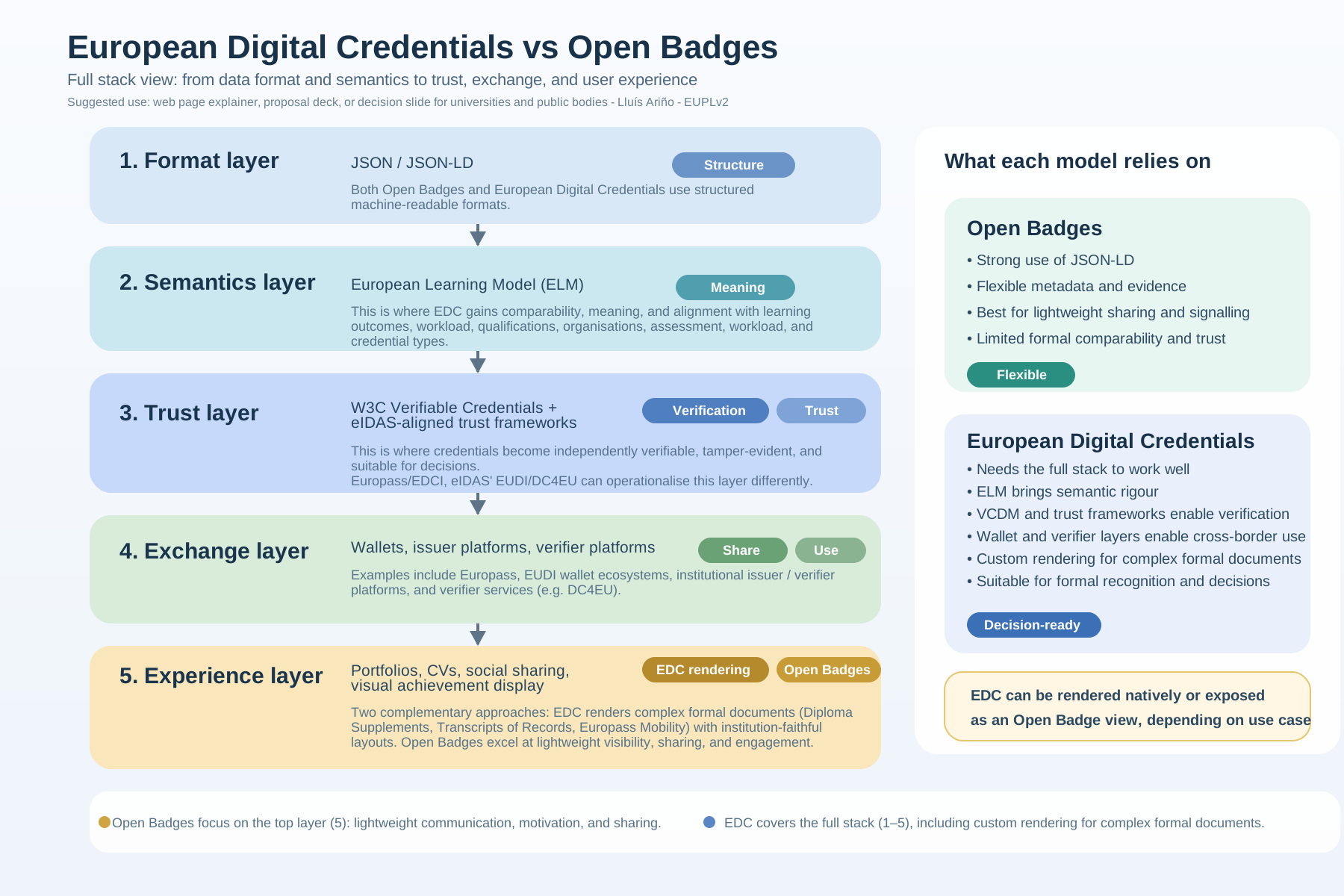
A European Digital Credential (EDC) records a learning achievement as structured data that its issuer signs digitally, so anyone can check it by cryptography alone, without contacting the awarding institution. Its content follows the European Learning Model (ELM), and recognition across borders was its purpose from the start rather than an afterthought. Delivery and storage differ by lineage: Europass/EDCI hands the learner a file, while the DC4EU/EBSI lineage was designed for wallets. EDC is built mainly on W3C-VCDM for the DC4EU/EBSI lineage (DC4EU also piloted SD-JWT VC), or on qualified-sealed JSON-LD for Europass/EDCI.
The four dimensions of an EDC
| Dimension | What it means | Why it matters |
|---|---|---|
| Structure | European Learning Model (ELM): issuer, holder, learning outcomes, workload (ECTS), EQF level, assessment method, quality assurance reference. | Shared semantics across Member States. A “learning outcome” in Spain means the same as in Finland. Machine-readable comparability. |
| Trust | Digitally signed. Issuer registered in national/EU trust framework. Cryptographic verification. Aligned with eIDAS regulation. | Independent verification without contacting the issuer. Tamper-evidence. Legal standing under EU law. |
| Portability | Depends on lineage. EDCI/Europass: credential delivered as a JSON-LD file, optionally stored in Europass. DC4EU/EBSI: designed for wallet delivery; in the EUDI Wallet, W3C VCDM is today an optional format, not a binding one. | The learner controls their credential. Wallet delivery is the design target of DC4EU/EBSI; optional in EDCI/Europass. |
| Legal alignment | Aligned with eIDAS 2.0, EQF, ESG, Bologna framework. Does not grant legal status alone — issuer accreditation still required. | Enables formal recognition processes, Lisbon Convention workflows, and EMREX integration. |
The European Learning Model (ELM)
ELM is what gives an EDC its meaning. It is an ontology: an agreed set of concepts and of the relations between them, so that software can read any credential and compare it with others, whatever the institution or country that issued it.
The key fields that ELM defines and that Open Badges does not:
- EQF level: the European Qualifications Framework level (1–8), given as an IRI from the Publications Office controlled vocabulary
- ECTS credits, with a framework reference and limits on the numeric value
- Assessment (provenBy), required in microcredentials and the main semantic feature that sets them apart from diplomas
- Awarding body and jurisdiction, with the issuer’s eIDAS legal identifier
- Quality assurance reference, required for a conformant microcredential
- Learning achievement specification: subject area (ISCED-F), learning mode and competences, for example referenced in ESCO
That is why a microcredential that follows the EU Council Recommendation (2022) cannot be built as an Open Badge: the Open Badges specification has nowhere to put the fields it requires.
Rendering for human readers. ELM also shapes how a credential is shown to people. As the Badges guide v1.1 (EUNIS SIG, July 2026), Badges and Digital Credentials in Higher Education, notes, W3C-VCDM lets the issuer attach rendering instructions to each credential instance, independently of its type. Universities in different countries can therefore share one ELM data model and one rendering approach and still produce documents faithful to each institution, such as a Diploma Supplement or a Transcript of Records, without defining separate schemas. Formats that tie display to the credential type push the other way: every institution that wants its own presentation needs its own type, and schemas multiply. The W3C mechanism, renderMethod, is still an experimental draft; see The W3C-VC stack.
Two EDC lineages — same regulation, different architecture
This is the distinction most documentation misses. There are two technically distinct lineages operating under the same EU regulatory framework. Choosing between them is a strategic and architectural decision.
| Europass / EDCI | eIDAS 2.0 / EBSI / DC4EU | |
|---|---|---|
| Status | Established — deployed across 40+ countries today | Wallet-oriented; EUDI Wallet support for W3C VCDM in education is foreseen once new profiles exist, not yet binding |
| Technical base | EDCI JSON-LD, qualified seals for signing | Mainly W3C-VCDM (DC4EU also piloted SD-JWT VC), DID/EBSI, QTSP/PSB-issued credentials |
| Storage / Wallet | Credential delivered as JSON-LD file; optional storage in Europass repository (not wallet-native) | Wallet-based: EBSI-conformant and other non-EUDI wallets; an EUDI Wallet only where the national wallet supports the optional W3C VCDM format |
| Trust model | Centralised: Europass trusted issuer list; classical PKI | Hybrid: classical PKI + verifiable data registries (EBSI) + trusted lists |
| Revocation / Suspension | Limited mechanisms | Bitstring Status List (formerly StatusList2021): revocation and suspension as distinct states |
| Best for | Immediate deployment: diplomas, transcripts, microcredentials | High-assurance, wallet-based, cross-border long term |
| eIDAS alignment | eIDAS 1.0 qualified seals | eIDAS 2.0 attestation categories (EAA, QEAA, PubEAA); in the EUDI Wallet, W3C VCDM is today optional and for non-qualified EAA only; SDG/OOTS compatible |
| Deployment readiness | Production | DC4EU pilot concluded in 2025; no EU-wide production service yet |
For an interactive view of these layers, see the interoperability map (2D and 3D).
What the signature covers. In the DC4EU/EBSI lineage, a W3C-VCDM credential in JSON-LD carries its @context, the reference to the shared ontology that defines each field, inside the signed payload. Checking the signature therefore also checks the meaning: that an EQF level of 7 means master’s level is part of what the issuer signed, not an interpretation the verifier adds afterwards. Semantics and cryptographic trust form one layer, which matters for cross-border recognition, where a qualification level has to mean exactly the same thing, and resist tampering, in every jurisdiction.
Important nuance within Europass/EDCI: the EDC produced by the Online Credential Builder (OCB) is JSON-LD inspired by the W3C-VCDM but not a fully compliant serialisation of it (top-level credential wrapper, no issuanceDate/expirationDate, no revocation). The W3C-VCDM compliant version is EDC-W3C, specified on VCDM 1.1 and being extended to VCDM 2.0. See the Sectorial EAA Catalogue for the full set of schemas and the EDC vs EDC-W3C distinction in depth.
EDC can sit at the top of the eIDAS 2.0 attestation hierarchy: issued by a QTSP or a public body as a QEAA or PubEAA, or sealed with an eIDAS 1.0 qualified seal (Europass/EDCI lineage). As a QEAA or PubEAA, an EDC has the legal effect of a lawfully issued paper attestation of attributes; an eIDAS 1.0 qualified seal gives a presumption of the integrity and origin of the data. The lowest tier, a non-qualified EAA issued by a TSP that is not in the QTSP list, is a legitimate option for microcredentials from private providers under the “shall not be denied” clause of Article 45f, but loses access to processes that require qualified status. See Trust spectrum for the three tiers.
The EUDI Wallet is a separate question. Since Implementing Regulation (EU) 2026/1731 (in force 11 August 2026), the binding annexes of the EUDI Wallet implementing acts name SD-JWT VC and ISO/IEC mdoc for person identification data and for attestations (ETSI TS 119 472-1 profiles). W3C VCDM is not among them today, but the regulation’s recitals state that wallets should also support it, as the reference format for attestations in education, once new W3C VCDM profiles are available. ARF v3.0 currently treats W3C VCDM as optional and for non-qualified attestations only. So an EDC-W3C credential is not a QEAA in the EUDI Wallet today; a qualified or public-body attestation delivered to the wallet would travel as SD-JWT VC or mdoc. See EUDI Wallet.
These lineages are not competing. They serve different timelines and use cases.
Europass/EDCI for deployment today. The DC4EU/EBSI lineage was built for wallets, but its pilot concluded in 2025: EUDI Wallet support for W3C VCDM in education is foreseen once new profiles exist, so keep an SD-JWT VC route open in the meantime.
An institution needs to know which data transfer model their use case requires before choosing architecture.
Data transfer models
The choice between EDC lineages is largely determined by the data transfer pattern — who sends what to whom, and whether the citizen is the intermediary:
| Model | Description | EDC lineage |
|---|---|---|
| LE → NP (Legal Entity to Natural Person) | Institution issues a credential directly to the student. The holder stores it in their wallet and shares as needed. Example: diploma, transcript, microcredential. | Both Europass/EDCI and DC4EU/EBSI work |
| LE → LE (Legal Entity to Legal Entity) | Institution shares data directly with another institution, without the citizen as intermediary. Example: partner university verifying enrolment for Erasmus. | Typically SDG/OOTS, Europass/EDCI, or direct API |
| LE → NP → LE (Citizen-mediated) | The citizen receives a credential, stores it in their wallet, and presents it to a relying party. Example: student presents EducationalID at a partner university. | DC4EU / EBSI / eIDAS 2.0 wallet paradigm |
What EDC demands from institutions
The requirements for issuing EDC are substantially higher than for Open Badges. This is not an argument against EDC — it is an argument for realistic planning:
- Being listed as a trusted issuer in the trust registry that applies
- For the DC4EU/EBSI lineage, managing Decentralised Identifiers (DIDs) and the keys behind them
- Populating every semantic field correctly against ELM v3.2
- Registering schemas and pointing to controlled vocabularies such as EQF, ISCED-F and ESCO
- Signing with qualified signatures or seals that meet eIDAS requirements
- Connecting to wallets to deliver the credentials
- Settling governance: who awards, which QA references apply, who acts as GDPR data controller
- Keeping the service running: rotating keys, maintaining revocation lists, versioning schemas
Long-lived credentials need a re-issuance plan. Current wallet infrastructure does not natively support credentials valid for five years or more, yet diplomas, degree certificates and professional qualifications last a working life. Define how a graduate obtains an updated credential when one expires or its schema changes, and explain the process to graduates before they need it: that is a governance and communications responsibility, not only a technical one. See Credential lifecycle.
Governance before technology — every time.
Legal entity, awarding authority, QA framework, and data controller designation must all be defined before any technical implementation begins.
Every technical shortcut taken before the legal and governance framework is defined creates rework.