
W3C-VC and SD-JWT are not two variants of one format. They are two stacks that answer two independent questions in opposite ways: where a credential’s meaning lives, and whether the proof is a detachable layer or the format itself. This page sets them side by side, following the comparison matrix and worked example in the VC guide v1.1 (EUNIS SIG, July 2026), Verifiable Credentials in Higher Education: W3C-VC and SD-JWT VC, and then traces what the differences look like inside one worked example, a single Master’s degree.
How to read the comparison
Do not count rows. The stacks are not competing on points. Several rows only matter for certain credential types: an institution issuing short-lived enrolment proofs can legitimately ignore half the table. The rows have to be weighted against the credential you intend to issue, which is what Choosing a stack is for.
The last column is the one that matters. The technical behaviour is in the specifications. What is worth adding is the translation into institutional consequence: cost, risk, liability and dependency. Read each row by asking whether that consequence applies to the credentials your institution issues.
The comparison matrix
| Dimension | SD-JWT | W3C-VC | What it means for your institution |
|---|---|---|---|
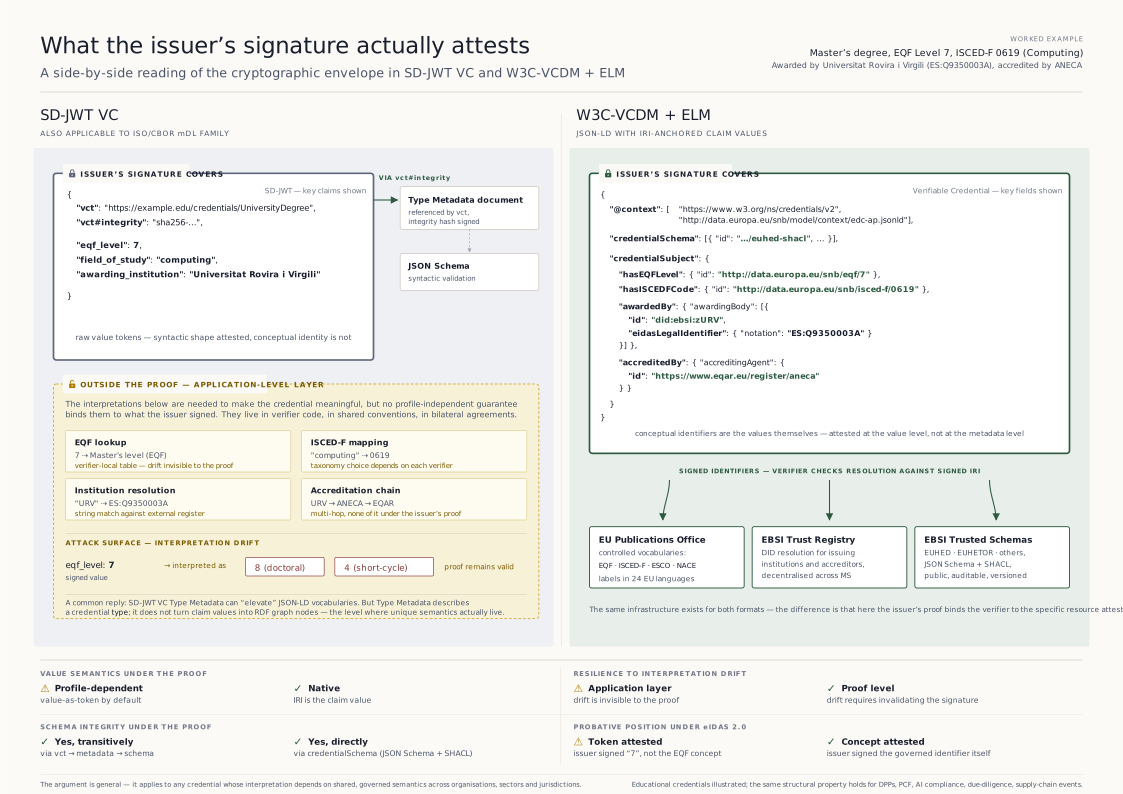
| 1. Where semantics live | Meaning sits outside what is signed, in documentation, verifier code and bilateral agreements; the issuer signs text values. | Meaning travels inside the signed payload through @context; data and meaning are signed together, so changing the meaning invalidates the signature. | A signed eqf_level: 7 can be read differently by different verifiers while the proof stays valid. Interpretation drift is invisible to the cryptography and surfaces years later as recognition disputes. |
| 2. Cross-border semantic interoperability | Needs bilateral mappings for each pair of countries, sectors and use cases; the set of mappings keeps growing as the ecosystem expands. | References shared ontologies (ELM, EQF, ESCO, ISCED-F) natively. Credentials pointing at the same concept are recognisably equivalent without prior agreement. | Shared semantic infrastructure is paid for once, at European level; bilateral mappings are paid for by every pair of parties, indefinitely. For cross-border credentials this is the dominant cost line. |
| 3. Formal validation | JSON Schema via schema_uri in Type Metadata: validates structure only. | Dual validation: JSON Schema for structure plus SHACL for graph semantics (value ranges, vocabulary membership, issuer constraints). | With structure-only validation, an out-of-range EQF level or an invalid ISCED-F code passes silently. With SHACL it is caught mechanically, and the validation report is itself machine-processable. |
| 4. Selective disclosure and unlinkability | Selective disclosure: yes. Unlinkability: no; signature and salted hashes are stable across presentations. Batch issuance mitigates, but needs volume forecasts, a lifelong issuer channel, and fails against verifier–issuer collusion. | Selective disclosure: yes. Unlinkability: yes with bbs-2023; each presentation carries a freshly derived proof that even colluding parties cannot correlate cryptographically (disclosed metadata aside). | Article 5a(16) of Regulation (EU) 2024/1183 bars post-issuance tracking and requires unlinkability where the user need not be identified. One stack delivers it cryptographically; the other approximates it operationally: a difference in regulatory exposure. |
| 5. Data protection by design (Art. 25 GDPR) | Minimisation and proportionality are procedural commitments of the controller, implemented in processes and code. | Minimisation (bbs-2023 reveals only what is needed) and purpose limitation (SHACL shapes bound to declared verifier purposes) are technical properties of the format. | Article 25 asks for protection embedded in the processing itself. On one stack the DPO points at the architecture; on the other the DPO defends procedures. In an inspection, that difference is material. |
| 6. Auditable accountability (Art. 5(2) GDPR) | Verifier validation rules live in application code: not bound to the credential, not auditable as a protocol property. | SHACL shapes registered in the EBSI Trusted Schemas Registry (TSR): hash-anchored, immutable, publicly resolvable. A regulator can retrieve the exact rules in force on any date. | Demonstrating compliance becomes a technical check rather than a documentary review; non-compliance is detected by inspecting an artefact, not by reconstructing behaviour over time. |
| 7. Revocation and suspension | Token Status List: revocation only in the European profiles, so valid or invalid. “On hold” collapses into “invalid”; reactivation means reissuance. | Bitstring Status List: revocation and temporary suspension, each a distinct native state. | Disciplinary proceedings, reviews and corrections need “suspended, pending resolution”. Without that state, the university either misrepresents the credential or handles the hold outside the credential layer. |
| 8. European semantic assets | ELM, ESCO, EQF and the Publications Office vocabularies are not natively integrable; semantics stay external. | All referenceable directly from the @context; existing EU investment in education semantics is inherited, not rebuilt. | Europe has already paid for a semantic infrastructure for education. One stack stands on it; the other rebuilds fragments of it in bilateral agreements. |
| 9. Platform independence and specification governance | The IETF governs the credential format and the OpenID Foundation the presentation protocols; the profiles inherit assumptions from consumer identity. | Any implementation of the published cryptosuites can verify it; eIDAS trust services and the EBSI registries can be integrated, though W3C VCDM is not yet among the formats the binding EUDI Wallet annexes name. | Strategic dependency is a procurement question. For decades-long commitments, know which standards bodies control your stack’s roadmap, and what recourse exists if it diverges from European regulatory needs. |
| 10. Human-readable rendering | Display is defined in Type Metadata, bound to the vct. Issuer-specific rendering means a new type; extends helps but multiplies types. | renderMethod attaches rendering to the individual credential, inside the signed object, but it is an early, experimental W3C draft with little wallet support yet. | Binding display to type couples visual identity to type proliferation across thousands of issuers; per-credential rendering avoids that but is less mature. A dimension to watch rather than decide on. |
| 11. Implementation cost and maturity today | Weeks to production. Ubiquitous JWT tooling, abundant skills, the deepest wallet support today; SD-JWT VC is required for PID and is one of the two attestation formats in the binding EUDI Wallet annexes. | Higher entry cost: DIDs, key infrastructure, ELM alignment, SHACL authoring. Wallet support for bbs-2023 is still maturing. | SD-JWT leads here, and it is not a small row. For a working pilot with real wallets this academic year, the shortest path is clear. The question is what the pilot commits you to. |
The pattern behind the rows
Rows 1 to 10 describe a single architectural fact from ten angles rather than ten separate facts: W3C-VC internalises what SD-JWT externalises. Meaning, validation rules, privacy guarantees, suspension states and audit trails sit either inside the credential and the artefacts it registers, or outside it, in documentation, procedures, code and agreements.
Externalising is a legitimate choice. It costs less, ships sooner and works well where the ecosystem is coordinated, the credential has a short life and issuer and verifier already know each other. The bill arrives when one of those assumptions breaks: a verifier nobody has coordinated with, a credential that is decades old, a regulator asking for evidence, a compensating procedure that was skipped. Row 11 is the cost of internalising, paid once and upfront; rows 1 to 10 are the cost of externalising, paid each time coordination fails.
This is also why most universities will run both stacks in two lanes: SD-JWT for short-lived, intra-scheme, semantically light credentials such as student ID, enrolment or access; W3C-VC for long-lived, cross-border, semantically dense and regulated ones such as degrees, formal microcredentials and professional qualifications.
In the EUDI Wallet the two stacks do not stand on the same footing today. Since Implementing Regulation (EU) 2026/1731 (in force 11 August 2026), the binding annexes of the EUDI Wallet implementing acts name SD-JWT VC and ISO/IEC mdoc for person identification data and for attestations (ETSI TS 119 472-1 profiles). W3C VCDM is not among them today, but the regulation’s recitals state that wallets should also support it, as the reference format for attestations in education, once new W3C VCDM profiles are available. ARF v3.0 currently treats W3C VCDM as optional and for non-qualified attestations only. See EUDI Wallet.
One degree, two stacks
The worked example used across this site is a hypothetical scenario: a Master’s degree in Computing, EQF level 7, issued in 2026 by Universitat Rovira i Virgili (URV) to a graduate we call Aina. The excerpts below are simplified and omit fields not relevant to the point.
What URV signs on the SD-JWT stack
{
  "vct": "https://credentials.example.es/UniversityDegree",
  "vct#integrity": "sha256-...",
  "iss": "https://urv.cat",
  "cnf": { "jwk": { ...Aina's wallet key... } },
  "_sd": [ "hash(salt1, eqf_level, 7)",
           "hash(salt2, field_of_study, 'computing')",
           "hash(salt3, degree_title, 'Master in Computing')" ]
}
Inside the signature: the string “computing”, the number 7, the issuer as a URL. Not inside: which framework the 7 belongs to, which classification “computing” maps to, and which legal entity stands behind urv.cat. Those answers live in the Type Metadata resolved from the vct, in verifier code and in whatever register the verifier consults. The signature attests tokens; interpretation is the verifier’s job.
What URV signs on the W3C-VC stack
{
  "@context": [ "https://www.w3.org/ns/credentials/v2",
                "http://data.europa.eu/snb/model/context/edc-ap" ],
  "type": [ "VerifiableCredential", "EuropeanDigitalCredential" ],
  "issuer": { "id": "did:ebsi:z...URV",
              "eidasLegalIdentifier": { "notation": "Q9350003A",
                "spatial": "http://publications.europa.eu/resource/authority/country/ESP" } },
  "validFrom": "2026-07-01T00:00:00Z",
  "credentialSubject": { "hasClaim": { "specifiedBy": {
      "eqfLevel": "http://data.europa.eu/snb/eqf/7",
      "iscedFCode": "http://data.europa.eu/snb/isced-f/0619" } } },
  "credentialSchema": [
    { "type": "JsonSchema", "id": "https://.../tsr/v3/schemas/0x05332a..." },
    { "type": "ShaclValidator2017", "id": "https://.../tsr/v3/schemas/0x..." } ],
  "proof": { "type": "DataIntegrityProof", "cryptosuite": "ecdsa-rdfc-2019", ... }
}
Inside this signature: not the number 7 but the IRI of the governed EQF concept; not the string “computing” but the ISCED-F code as an IRI; not a URL but a DID that resolves in the EBSI registries and carries an eIDAS legal identifier with explicit jurisdiction; and both validation schemas, anchored by hash in the TSR. The signature attests concepts, identity and validation rules together. Every divergence below grows from that one difference.
Four divergences, four lines in the payload
- Interpretation drift: the verifier in Tallinn. An Estonian university receives Aina’s degree for doctoral admission, with no prior coordination with URV. On SD-JWT it sees
eqf_level: 7and must ask “seven on which scale?”; a local mapping table answers, and if that table drifts the degree may be read as doctoral or short-cycle while the proof validates identically. On W3C-VC the software resolves the EQF IRI and lands on the same concept URV signed. There is no local table to drift. - Colluding verifiers. Aina shows her degree to a recruitment platform in March and a licensing body in November, disclosing different attributes. On SD-JWT both hold the same issuer signature and the same
_sdhashes, so the presentations link trivially if they (or either of them and the issuer) compare records. On W3C-VC with bbs-2023 each holds a proof derived fresh for that presentation, with no shared cryptographic material to compare; metadata can still correlate, though, if a status-list index or a unique credential identifier is disclosed every time and the design does not hide it. More on selective disclosure vs unlinkability. - The disciplinary hold. An integrity review touches Aina’s cohort, and her credential is on hold for eleven weeks. On W3C-VC,
credentialStatuspoints to a Bitstring Status List entry that URV sets to suspended and later back; the credential never changes. On SD-JWT, the Token Status List supports revocation only in the European profiles, so it offers valid or invalid; the honest state, on hold, has no encoding. - The key-rotation event. In 2038 URV rotates its signing infrastructure and moves to a post-quantum suite. On SD-JWT the signature is the outermost fact of the object, so a new signature means a new credential, issued again to every holder. On W3C-VC the proof block is one replaceable member of the object: URV re-secures it, and the
@context, IRIs, schemas and credential identity stay untouched. Re-securing still requires getting the new proof to each holder; what survives is the credential’s identity, content and meaning, not the need for a delivery channel. Key rotation alone, without an algorithm being deprecated, forces reissuance on neither stack as long as historic public keys remain resolvable. See Credential lifecycle.
The payloads alone mislead in one direction: they show what each stack internalises, not what each costs to deploy. They do not show that, in a scenario like this one, SD-JWT issuance typically takes weeks to set up while W3C-VC takes quarters, that wallet support for bbs-2023 is still maturing, or the governance work behind the eIDAS legal identifier, which no format provides for free.
EUNIS SIG position
For formal, regulated, long-lived European educational credentials (and only for those), the EUNIS SIG argues that the regulation itself names the deciding properties: unlinkability where the attestation does not require identifying the user, data protection by design, demonstrable accountability and suspension. W3C-VC delivers them as properties of the format, whereas SD-JWT leaves them as commitments of the controller. The position is explicitly not a claim that SD-JWT is deficient at what it was designed for; the full argument is set out in Choosing a stack.
Read against the wallet rules in force, the binding EUDI Wallet formats today are SD-JWT VC and mdoc, and Implementing Regulation (EU) 2026/1731 itself anticipates W3C VCDM support for education once new profiles exist. In the wallet, the formal lane therefore depends on those profiles arriving, and institutions should meanwhile keep an SD-JWT VC route for wallet delivery.
Key points
- Do not count rows; weight them against the credential you intend to issue, and read the consequence column first.
- One pattern underlies the matrix: W3C-VC internalises meaning, validation, privacy, status and audit; SD-JWT externalises them into procedures and agreements.
- SD-JWT’s lead on cost, tooling and wallet support today is real and decisive for short-lived, coordinated credentials; SD-JWT VC is also one of the two formats the binding EUDI Wallet annexes name.
- In one degree, the divergences trace to specific lines: flat values vs IRIs, stable hashes vs fresh proofs, two status states (Token Status List as profiled in Europe) vs three, a welded signature vs a replaceable proof block.
- Most universities will run both stacks, in two lanes, rather than pick a single winner.
← The SD-JWT stack · Credentials · Selective disclosure vs unlinkability →