
An academic credential is not an event; it is a commitment. A degree issued this year will be presented, checked, occasionally questioned and repeatedly re-secured for the rest of its holder’s working life. Pilots and procurement exercises almost always measure only the first moment of that life. This page follows one credential across three decades, using the hypothetical worked example from the VC guide v1.1 (EUNIS SIG, July 2026), Verifiable Credentials in Higher Education: W3C-VC and SD-JWT VC: a Master’s degree in Computing, EQF level 7, issued in 2026 by Universitat Rovira i Virgili (URV) to a graduate we call Aina, once on each of the two stacks.
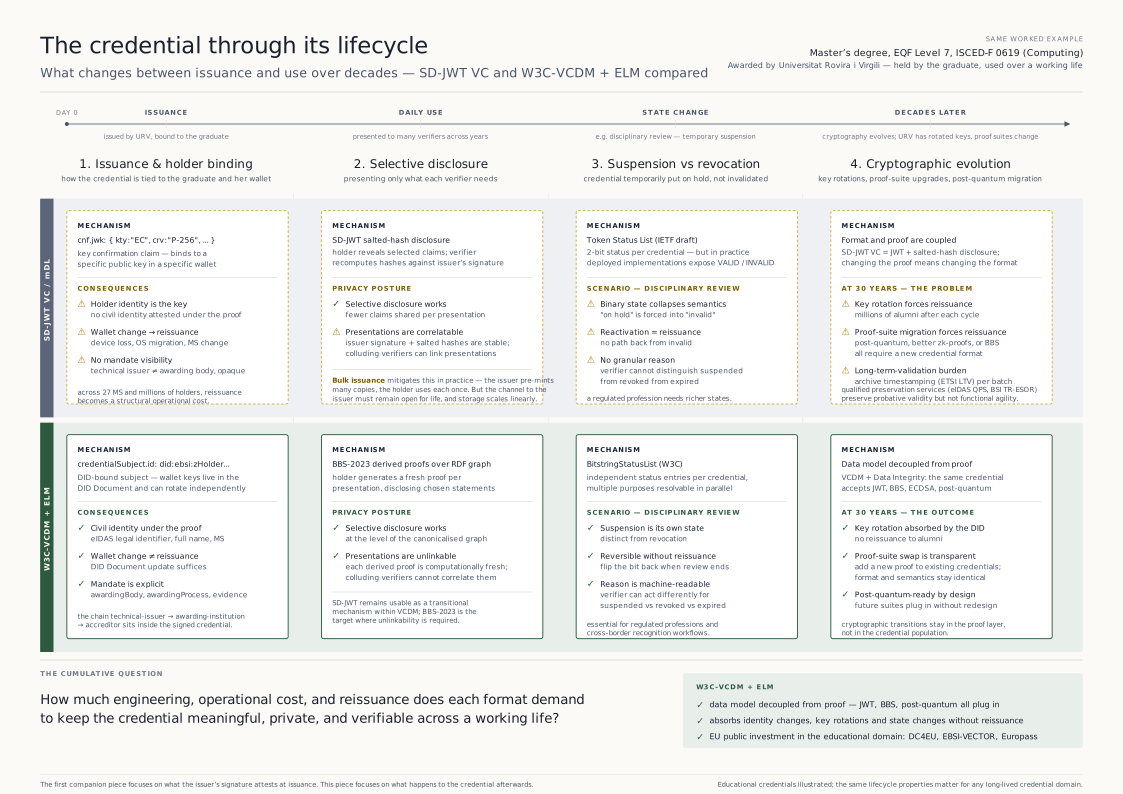
Milestone 1: issuance and holder binding (2026)
On the SD-JWT stack, URV issues a JWT whose disclosable claims are replaced by salted hashes, bound to a key in Aina’s wallet through the cnf claim. Issuance is quick, the wallet flow smooth, and Aina holds a working credential that same afternoon. On the W3C-VC stack, URV issues a VCDM 2.0 credential whose fields reference ELM, EQF and ISCED-F concepts through the @context, secured with a Data Integrity proof and pointing to its JSON Schema and SHACL shape in the EBSI Trusted Schemas Registry. In the scenario, setup takes longer (registries, DIDs, semantic alignment), but Aina notices no difference: her wallet shows a degree either way.
One issue at this milestone is shared by both stacks. Holder binding ties the credential to keys in Aina’s wallet, and today those keys are usually bound to a single device. Over thirty years Aina will change phones many times. Binding to user claims rather than hardware, or synchronising bound keys across devices as consumer passkeys do, are both under discussion and neither is settled. It is not a differentiator between the stacks but an open problem of the wallet layer that every long-lived credential inherits.
At this milestone the stacks differ only in what the institution paid. That is why evaluations run at pilot stage systematically favour the cheaper setup: everything a pilot measures happens here, and almost everything that matters happens later.
Milestone 2: presentations across a career (2026–2056)
Aina presents her degree many times: to employers, professional bodies, a foreign university for doctoral admission, a licensing authority. On SD-JWT she discloses only the claims each verifier needs, exactly as designed. But the issuer’s signature and the salted hashes travel unchanged in every presentation, so any two verifiers who compare records, or any verifier who sees her twice, can correlate her. Her degree becomes, in effect, a persistent identifier.
Batch issuance blunts this: URV pre-mints many single-use copies. That only works if someone forecasts how many presentations a thirty-year career will need, the wallet looks after the stock of copies and the issuer channel stays open for life; and it offers no protection when a verifier and the issuer pool their records. On W3C-VC with bbs-2023, each presentation carries a freshly derived proof; verifiers comparing notes hold cryptographically unrelated objects, with nothing required from Aina or from URV after issuance. Metadata can still correlate, though: a status-list index or a unique credential identifier disclosed in every presentation is a stable handle unless the design hides it, for example with large, cached status lists. On one stack presentation privacy is a design property; on the other it is an operational programme the university runs for as long as its alumni are working. See Selective disclosure vs unlinkability.
Milestone 3: the disciplinary review (2031)
Five years on, an academic integrity investigation touches Aina’s cohort. URV must place the affected credentials on hold, pending resolution; most cases, including Aina’s, will close with no finding.
On W3C-VC, URV sets the suspension status in the Bitstring Status List. Verifiers see “suspended” for eleven weeks; when the review clears her, the status returns to valid. Nothing is reissued and the record is accurate throughout. On SD-JWT, the Token Status List supports revocation only in the European profiles, so it knows valid and invalid and nothing in between. URV must choose between two bad options: mark the credential invalid, telling every verifier something false and stigmatising about someone who will be exonerated and committing to reissue it afterwards; or leave it valid and manage the hold through internal procedure, so the credential layer says something the institution knows may be untrue. Institutions do not choose whether reviews happen, only whether their format has a state that matches reality when they do.
Milestone 4: cryptographic evolution (2038 and beyond)
This is the milestone procurement rarely prices. Signing keys rotate as a matter of hygiene, algorithms are deprecated, and somewhere in a thirty-year life sits the post-quantum transition, whose date is unknown and whose arrival is not.
On SD-JWT, the proof is the format itself. When URV’s 2026 signing algorithm is deprecated, every credential signed with it must be reissued: not only Aina’s but the whole alumni base accumulated since adoption, many unreachable, some deceased, all outside any active relationship with the university. On W3C-VC, the data model is decoupled from the proof, so migration is a proof-layer event: URV re-secures credentials with a new cryptosuite, or issues derived proofs under it, while content, meaning and schema references survive untouched. Re-securing still requires getting the new proof to each holder; what survives is the credential’s identity, content and meaning, not the need for a delivery channel. Key rotation alone, without an algorithm being deprecated, forces reissuance on neither stack as long as historic public keys remain resolvable. The same seam lets a credential issued today under an enveloping proof move to bbs-2023 once wallets support it.
Two refinements keep this honest. First, archival preservation is not function: long-term-validation timestamping under ETSI schemes and qualified preservation services can keep the probative value of old credentials, but a credential that is valid only inside an archival wrapper no longer works in a wallet, and each cryptographic cycle adds another layer to maintain. Second, refresh is not re-issuance: under OpenID4VCI a wallet can obtain an updated credential silently while its refresh token is valid, but those tokens last hours to weeks, so over decades refresh automates the paperwork of re-issuance rather than removing it. The W3C data model’s refreshService property carries the renewal route inside the credential; in SD-JWT it lives outside, in issuer metadata and protocol configuration.
A liability curve, not a purchase
A credential format is best read as a liability curve. On SD-JWT the curve begins low but jumps at each cryptographic event, and each jump scales with the number of alumni holding credentials at that moment. On W3C-VC it begins high and then stays nearly flat. For a few thousand short-lived credentials, reissued every term anyway, the two lines may never cross within the credentials’ useful life. For degrees they will; only the year is uncertain. That is why most universities end up with two lanes, as discussed in Choosing a stack.
The four milestones at a glance
| Milestone | SD-JWT | W3C-VC |
|---|---|---|
| 1. Issuance and holder binding (2026) | Fast to set up; mature wallet flows; credential the same afternoon. Device-bound keys an open problem. | Higher setup cost (DIDs, registries, ELM alignment); same holder experience. Device-bound keys an open problem. |
| 2. Presentations (2026–2056) | Selective disclosure, but stable signature and hashes make presentations linkable; batch issuance as a lifelong operational workaround. | Selective disclosure and unlinkability with bbs-2023: a fresh proof per presentation, no ongoing issuer involvement; disclosed status indexes or identifiers must still be designed not to correlate. |
| 3. Disciplinary review (2031) | Token Status List (revocation only in the European profiles): valid or invalid. A hold means a false “invalid” plus reissuance, or a status the institution knows may be untrue. | Bitstring Status List: suspend for eleven weeks, then reinstate. No reissuance; accurate record throughout. |
| 4. Cryptographic evolution (2038+) | Reissuance to the whole alumni base; archival preservation keeps evidence, not function; renewal route outside the credential. | Proof-layer migration; content and meaning untouched, though the new proof must still reach each holder; refreshService carries the renewal route inside the credential. |
Key points
- Pilots measure milestone one; a degree lives through all four.
- Device-bound holder keys are an unsolved wallet-layer problem for both stacks.
- Presentation privacy is a cryptographic property with bbs-2023 and an operational programme with batch issuance.
- Suspension either exists as a status (Bitstring Status List) or becomes a procedural and legal improvisation (Token Status List, revocation only in the European profiles).
- Cryptographic evolution means proof-layer migration on one stack and reissuance to every graduate on the other; archiving preserves evidence, and refresh tokens do not span decades.